
White Noise For Toddlers At Bedtime
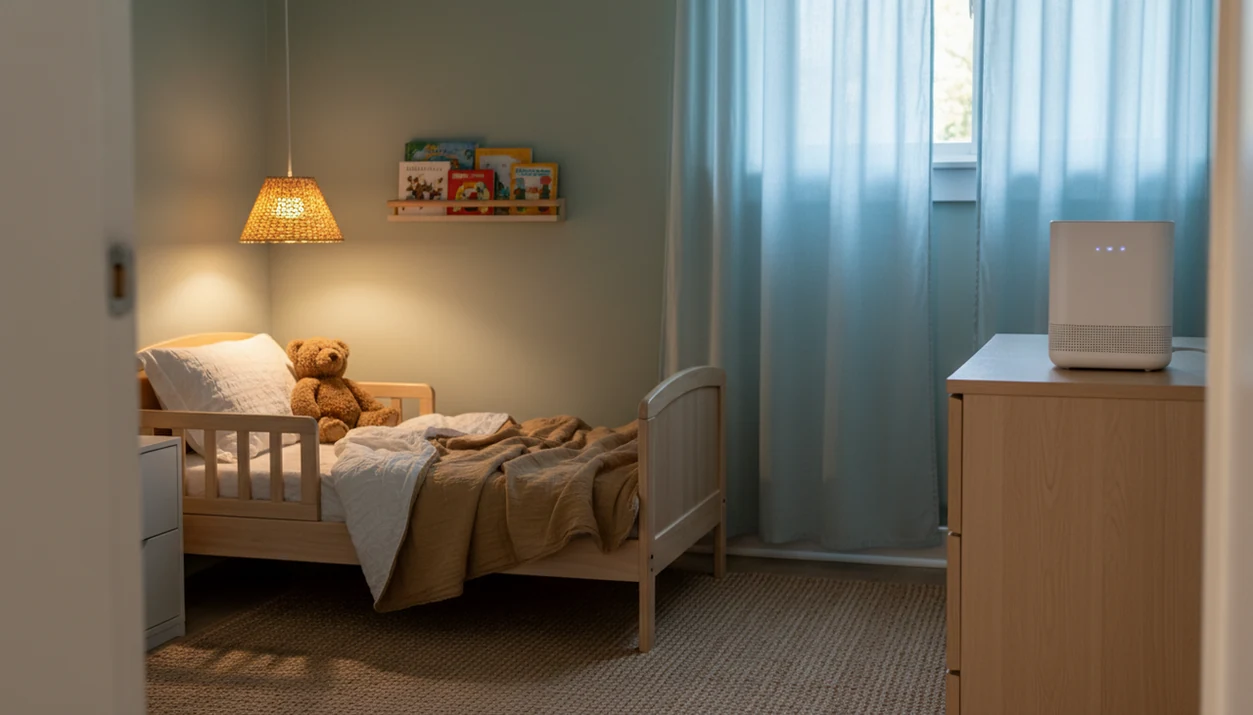
White noise for toddlers can help mask sudden household or street sounds at bedtime, but it should be kept low, placed far from the bed, and used as one part of a calming routine. A practical safety target is moderate volume, distance from the child’s head, and a timer or automatic shutoff when possible.
This page is general sleep-safety information for parents, not medical advice. If your toddler snores, pauses breathing, has pain, or has a sudden major sleep change, ask a pediatrician rather than trying to solve it with sound.
> Definition: White noise for toddlers is a steady background sound, such as a fan, soft static, rain, or ocean waves, used to make a sleep space feel more consistent by masking sudden noises.
TL;DR
- Keep toddler white noise moderate: many experts use about 50 dB or lower as a practical upper limit, with quieter often better.
- Place the sound source away from the bed, ideally at least 7 feet or about 2 meters from your toddler’s head.
- Use white noise as a bedtime support, not a cure for sleep problems, and pair it with stories, lullabies, dim lights, and a predictable routine.
White Noise For Toddlers: At-A-Glance Safety Guidance
White noise may help toddlers by masking sudden sounds, not by forcing sleep. The safer approach is low-to-moderate volume, distance from the bed, and a timer-friendly setup when possible.
Think of it as background cover for barking dogs, hallway footsteps, or an older sibling closing a door too hard. It should not be loud enough to dominate the room. From the bed, the sound should feel soft and steady, closer to a quiet shower in another room than a vacuum.
Some toddlers dislike white noise. Others begin to expect it every time they sleep, which can make naps at daycare or grandparents’ homes harder.
Tools like Kids Bedtime TL can support the quieter parts of the bedtime routine with stories, lullabies, sleep meditation, and nap routines, while white noise stays in the background.
How White Noise Bedtime Sound Works For Toddlers
White noise works through sound masking: a steady layer of audio makes sudden peaks less noticeable to the sleeping brain. In plain terms, the creaky floorboard does not stand out as sharply.
This can matter in apartments, shared rooms, street-facing bedrooms, or sibling-heavy homes where the settling window is easily broken. We notice it most during the 7:15 p.m. scramble after pajamas, toothbrush, and one missing stuffed rabbit. A low, steady track can keep the room from feeling acoustically jumpy.
White noise does not sedate a child. It also does not solve behavioral sleep struggles, pain, reflux, anxiety, sleep-disordered breathing, or big routine changes.
Repeated nightly, steady audio can become a calm-down cue. That is useful for some families, but it is still a cue, not a treatment. The most common practical use of white noise at bedtime is gentle sound masking combined with a predictable sequence.
Five White Noise For Toddlers Facts Parents Should Know
- White noise masks sudden sounds. It can soften traffic, siblings, pets, doors, creaky floors, and the small clatter that happens after bedtime in real homes.
- Toddler white noise safety depends mainly on volume and distance. A quiet sound across the room is different from a loud phone beside a pillow.
- Evidence suggests possible sleep help for some children, but toddler-specific proof is limited. A small classic newborn study found faster sleep onset with white noise, but toddlers are not newborns: https://www.ncbi.nlm.nih.gov/pmc/articles/PMC1662864/.
- White noise can become a sleep association. If it plays every night, your child may expect the same sound before sleep.
- White noise works best with a wider routine. Stories, lullabies for toddlers, dim light, and a steady bedtime order make the sound less of a single point of failure.
The hallway light left cracked open matters too. Toddlers read the whole room.
Toddler White Noise Safety Volume And Distance Rules
How loud should white noise be for a toddler? A practical target is about 50 dB or lower, with quieter preferred if it still masks the disruptive sound. The World Health Organization recommends nighttime continuous indoor bedroom sound levels around 40 dB to reduce sleep and health effects, so 'soft' is the safer direction: https://www.who.int/europe/publications/i/item/9789289041737.
A Pediatrics study of 14 infant sleep machines found that all could exceed recommended noise limits at common crib distances, and some exceeded 85 dB at maximum volume: https://publications.aap.org/pediatrics/article/133/4/677/32799/Infant-Sleep-Machines-and-Hazardous-Sound-Pressure. That does not mean every machine is unsafe; it means settings and placement matter.
Safe volume check
Set the sound where your toddler sleeps, then check it from the bed location with a smartphone decibel meter. Phone meters are not lab tools, but they can catch obvious problems. If the number jumps or the sound feels intrusive, turn it down.
Safe placement check
Place the machine or phone at least 7 feet, or about 2 meters, from your toddler’s head. A dresser across the room is usually better than a bedside table.
White Noise Bedtime Routine With Stories And Lullabies
Use white noise after the calming routine has started, not as the only sleep strategy. A simple order is bath or cleanup, pajamas, story, lullaby or sleep meditation, dim room, then soft white noise.
The phone can sit face-down on a dresser so the screen does not brighten the room. That small choice helps keep the sound from turning into a new source of stimulation.
Kids Bedtime TL is a kids bedtime stories app that provides bedtime stories, sleep meditation, lullabies, and nap routines for parents of toddlers and young children. Good kids bedtime stories, sleep meditation, lullabies, and nap routines for toddlers and young children give families a predictable wind-down path, not a guaranteed sleep outcome.
Avoid layering loud white noise over loud music, videos, or high-energy content. If you are choosing between sound types, the lullabies vs sleep stories question often comes down to whether your child calms with melody, language, or silence.
Common White Noise For Toddlers Myths
- Myth: White noise is risk-free at any volume. Safety depends on keeping it moderate and away from the child’s head.
- Myth: Louder white noise works better. Louder sound may cover more noise, but it also raises hearing-risk concerns. Gentle masking is the goal.
- Myth: White noise fixes all toddler sleep problems. It cannot treat anxiety, breathing issues, pain, reflux, or a bedtime routine that has become too stimulating.
- Myth: Baby studies prove every toddler will respond the same way. Infant data is useful context, but toddlers have different habits, fears, language, and preferences.
- Myth: Stopping white noise must happen all at once. Many families do better with gradual volume reductions over several nights.
A low hum under a soft-spoken story can be enough. More sound is not always more settling.
White Noise Bedtime Weaning And Travel Plans
White noise can become a sleep association, which means your toddler may expect the same sound to fall asleep. That is not automatically bad, but it can matter when daycare naps, grandparents’ homes, or travel nights do not match home.
To wean, reduce the volume a little every few nights instead of removing it abruptly. If your child notices, hold the rest of the routine steady. Same pajamas. Same phrase. Same story order.
For travel, keep a backup option, but do not compensate for an unfamiliar room by pushing the volume to maximum. Airport pajamas in a diaper bag are already enough change for one evening. Offline stories, quiet songs, or sleep sounds for kids can help the routine feel familiar without making volume the main tool.
When To Ask A Pediatrician About Toddler Sleep
Ask a pediatrician when sleep trouble comes with breathing concerns, pain, distress, or a sudden change that does not fit the usual bedtime bumps. White noise should make the room feel steadier; it should not cover up a medical or developmental concern.
Snoring, gasping, pauses in breathing, or labored nighttime breathing deserve professional advice. So do reflux-like symptoms, repeated complaints of pain, intense anxiety, night terrors that worry you, or a sharp sleep regression after your toddler had been settling well. Before turning the volume up or adding a fan, app, and sound machine together, pause and check whether the problem needs a clinician rather than more noise.
- Write down when the sleep change started, what bedtime looked like, and whether naps changed too.
- Record the type of sound you hear, such as snoring, choking, coughing, crying, or panicked waking.
- Check the white noise volume and where the device sits in the room.
- Share patterns with your pediatrician, including illness, reflux signs, fears, new medications, or recent routine changes.
- Ask before increasing volume or layering multiple sound sources to push through the problem.
Limitations
White noise is a practical bedtime support, but it has real limits. Clinicians typically recommend asking a pediatrician about snoring, breathing pauses, major sleep changes, pain, or ongoing distress rather than relying on sound alone.
- Evidence for white noise is stronger in infants and small studies than in older toddlers.
- White noise does not treat anxiety, sleep apnea, restless legs, pain, reflux, or other medical issues.
- Some toddlers find white noise irritating, distracting, or overstimulating.
- Too much volume or too-close placement may create hearing-risk concerns.
- White noise can become a strong sleep association that complicates naps away from home.
- A timer may help reduce overreliance, but some children wake when the sound stops.
- Shared bedrooms can be tricky if one child relaxes with white noise and another dislikes it.
- Videos, bright screens, and loud layered audio can undermine the calm-down cue.
For many families, a short read-aloud, a quiet sound, and dim lighting are easier to repeat than a long negotiation. If your child responds better to music, how lullabies help children relax covers that gentler sound path.
FAQ
Is white noise safe for toddlers?
White noise can be safe for toddlers when it is kept moderate, placed away from the bed, and not used as a substitute for medical advice. Ask a pediatrician about snoring, breathing pauses, pain, or major sleep changes.
How loud should toddler white noise be?
A practical maximum is about 50 dB or lower, with quieter preferred when it still masks disruptive noise. Check from the bed location, not beside the machine.
Where should a sound machine go?
Place the sound machine away from the bed, ideally at least 7 feet or about 2 meters from your toddler’s head. A dresser across the room is usually safer than a bedside table.
Can white noise damage hearing?
Gentle, distant white noise is not the main concern. Excessive volume and close placement are the hearing-risk issues parents should avoid.
Should white noise play all night?
A timer or automatic shutoff can reduce overreliance, but some toddlers wake when the sound stops. Choose the lowest consistent setup that works for your home.
Can toddlers become dependent on white noise?
Yes, toddlers can form a sleep association with white noise. Gradual volume reduction and flexible backup routines can make daycare, travel, and naps easier.
Is a fan enough white noise?
A fan can work if it is steady, safe, not too loud, and not pointed uncomfortably at the child. Keep cords secure and place it away from the bed.
When should parents stop white noise?
Stop or reduce white noise if your toddler dislikes it, sleeps well without it, or needs more flexibility for travel and naps. Reduce gradually if sudden removal causes bedtime disruption.