
How Loud Should Lullabies Be for Toddlers?
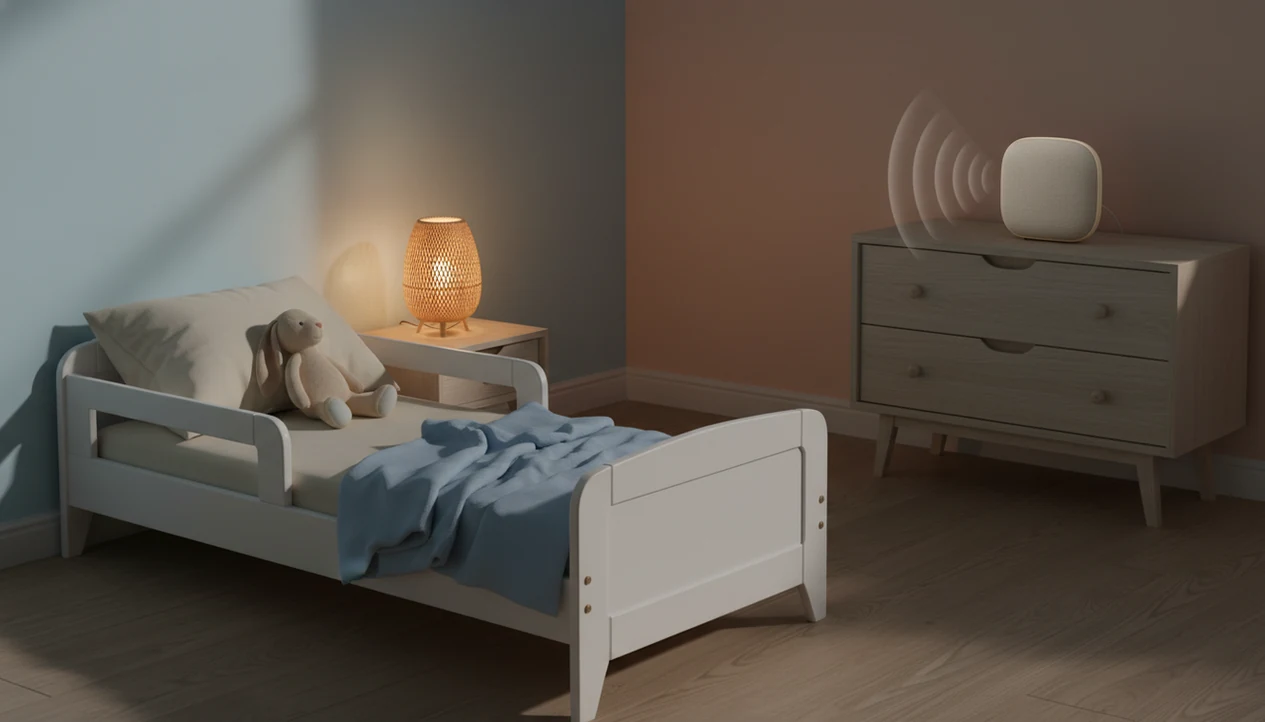
Keep toddler lullabies quiet: about 50–60 dB at your child’s ear, placed several feet from the bed, and set only loud enough to soften household noise. If you are asking how loud should lullabies be for toddlers, the safest practical answer is “background sound,” not room-filling music.
Safe bedtime audio for toddlers means lullabies, sleep music, or gentle sound played at a moderate volume, away from the child’s head, for a controlled bedtime routine.
This is general hearing-safety and bedtime-routine guidance, not a diagnosis or individualized medical recommendation. If your toddler has hearing concerns, ear infections, prematurity, developmental differences, or strong sensory reactions, ask a pediatrician or pediatric audiologist what volume and duration are appropriate.
- Aim for roughly 50–60 dB at pillow level, closer to quiet background sound than entertainment volume.
- Place speakers or sound machines at least 6–7 feet from the toddler’s bed whenever possible.
- Use the lowest effective volume, check it with a decibel app, and consider a timer if the audio is mainly for settling.
Safe Lullaby Volume for Toddlers at a Glance
For lullaby volume toddler safety, aim for about 50–60 dB at your child’s ear. That should feel like quiet background sound, not music filling the whole bedroom.
In normal parent terms, the volume should sit near a quiet conversation, gentle rain, or a soft shower in the next room. Place the speaker several feet from the bed, not beside the pillow or tucked near a sleep sack zipper under sleepy chins. The goal is to soften hallway noise and household bumps, not cover everything.
Use the lowest effective volume. If the lullaby is mainly a settling cue, set a timer for the settling window instead of assuming it needs to run all night.
Quiet is doing the work.
Five Facts About Sleep Music Volume for Kids
- Aim for 50–60 dB at the toddler’s ear, measured where the child actually sleeps.
- Keep phones, speakers, and sound machines at least 6–7 feet from the sleeping area when the room allows it.
- Use the lowest volume that masks disruptive sounds, such as a sibling in the hallway or a door closing downstairs.
- Avoid prolonged exposure above safe limits, especially sound that reaches 70 dB or higher for long stretches.
- Check sleep music volume kids hear at pillow height with a decibel app, then confirm with the conversation test.
A normal adult voice should still work in the room. If you have to talk over the lullaby during the 7:15 p.m. scramble after pajamas, toothbrush, and one missing stuffed rabbit, the setting is probably too high.
For most families, safe bedtime audio is measured at the pillow, not on the device screen.
How Safe Bedtime Audio Works for Toddler Sleep
Safe bedtime audio works by reducing contrast. A steady, gentle sound makes sudden household noises feel less sharp against a quiet room, but masking does not require overpowering the space.
The useful term is “auditory masking.” In plain language, the lullaby or soft noise takes the edge off unpredictable sounds. Over time, the same song, story, or low hum can also become a calm-down cue in a predictable sequence. The phone set face-down on a dresser helps too, since the screen does not brighten the room.
Tools like [Kids Bedtime TL]() can fit this role when families use stories, sleep meditation, lullabies, and nap routines as calm routine audio. Good kids bedtime stories, sleep meditation, lullabies, and nap routines for toddlers and young children deliver a predictable settling cue, not a guaranteed sleep result.
For toddlers, gentle audio usually works best when it supports a repeated bedtime routine, while louder playback mostly adds unnecessary sound exposure.
Why 50–60 dB Is the Practical Lullaby Volume Toddler Range
A decibel, or dB, is a measure of sound level at the listener’s ear. For toddler lullabies, 50–60 dB is a practical bedtime range because it maps to quiet, familiar sounds.
Think quiet conversation, gentle rain, or a soft shower. The American Academy of Pediatrics has recommended keeping hospital nursery sound levels at or below 50 dB to protect infants’ hearing, which is useful pediatric context even though a toddler bedroom is not a nursery unit source. The CDC notes that prolonged exposure to noise above 70 dB can damage hearing over time for children and adults source.
Clinicians typically recommend reducing unnecessary noise exposure rather than treating louder sleep sound as more effective. There is no toddler-only universal legal limit for lullabies at home, so parents need practical guardrails: moderate volume, distance from the head, and regular checks.
The most common medically supported way to reduce bedtime audio risk is lower volume combined with more distance from the ear.
Speaker Distance for Safe Bedtime Audio Near a Toddler Bed
Where should a speaker go for safe bedtime audio near a toddler bed? Place it at least 6–7 feet from your toddler’s head when possible, and never put it in the crib, on the bed, or beside the pillow.
Distance matters because sound level drops before it reaches the ear. A device on a dresser across the room is usually easier to manage than a speaker on the mattress. If hallway noise is the problem, place the device between the door and the child, not next to the child.
That setup often lets you use a lower setting. We have seen this work during the familiar hallway-light-cracked-open moment, when a parent starts the same story again and wants the room to stay calm without turning the sound up.
For broader sound options, our guide to sleep sounds for kids covers gentle audio without overstimulation.
How to Check Sleep Music Volume for Kids at Home
Use a decibel meter app as a practical estimate, not as a medical instrument. Measure from your toddler’s pillow or ear level, because that is the sound your child receives.
- Set the device where you plan to leave it overnight or during the settling window.
- Play the actual lullaby, story, or sound track at the usual volume.
- Hold the decibel app at pillow height, not beside the speaker.
- Lower the volume if readings approach or exceed 60 dB at the pillow.
- Recheck after changing tracks, devices, furniture, or room layout.
Also use the normal-conversation test. An adult should be able to speak near the bed without raising their voice over the audio.
Tracks vary more than parents expect. A soft piano lullaby may sit lower than a story with a bright intro, so check the loudest part, not just the first ten seconds.
Lullabies, White Noise, and Sleep Music Volume Compared
Volume safety depends more on dB at the ear than on whether the audio is a lullaby, white noise, pink noise, brown noise, or narrated story. The label matters less than the measured level at pillow height.
| Audio type | What to watch | Practical bedtime note |
|---|---|---|
| Lullabies | Musical peaks and louder choruses | Set lower if the song swells suddenly. |
| White noise | Continuous exposure | Keep steady sound quiet and away from the bed. |
| Pink or brown noise | Deep low tones | Check at pillow height, since bass can feel softer than it measures. |
| Narrated bedtime stories | Voice changes, intros, and effects | Choose soft-spoken narration and avoid dramatic volume jumps. |
Music with sudden peaks may need a lower device setting than steady noise. Content from Kids Bedtime TL should be used as calm routine audio, not loud entertainment. If you are comparing formats, the lullabies vs sleep stories guide explains when each fits better.
A sibling listening from the top bunk may ask for more volume. That does not mean the toddler’s pillow needs it.
Playback Duration and Timers for Safe Bedtime Audio
Low-volume audio may be used longer, but parents should still use the lowest effective volume. Duration matters more as volume rises, so a quiet track across the room is different from a loud sound machine beside the bed.
Timers are often a better fit for toddlers who only need sound during settling. Set the timer before the lullaby starts, then let the same predictable sequence carry bedtime forward. Some children sleep fine with all-night sound, but others begin to need it every time they stir.
NIOSH exposure guidance for workplace noise shows why volume and time belong together: as sound levels rise, recommended exposure time drops sharply source. That is not toddler bedtime guidance, but it helps explain why louder all-night playback is the wrong direction.
For families deciding on overnight playback, is it safe to play lullabies all night goes deeper into sleep associations and timers.
When Lullaby Volume for Toddlers May Be Too Loud
These are the common signs that lullaby volume for toddlers should come down:
- Room-filling sound: The audio dominates the bedroom instead of sitting in the background.
- Raised voices: You need to speak louder than normal near the bed.
- High pillow readings: A decibel app shows more than 60 dB at pillow level.
- Crib-side placement: The speaker or phone is on the bed, in the crib, or beside the pillow.
- Maximum-volume devices: The machine is turned up because the toddler likes it loud.
Toddlers liking loud audio does not make it safe. A Pediatrics study found that some infant sleep machines exceeded 85 dB at maximum volume when measured close to the crib, which is why distance and settings matter source.
If your child has ear problems, prematurity, hearing concerns, neurodivergence, or strong sensory reactions, ask a pediatrician or audiologist for individualized advice. For gentler music ideas, see lullabies for toddlers.
Limitations
Safe bedtime audio guidance is practical, but it is not exact for every child or every room.
- Long-term research is limited on years of nightly toddler lullaby use at home.
- Many thresholds come from hospital, infant, occupational, or general hearing-safety guidance.
- Phone decibel apps are estimates and may not be calibrated.
- Some toddlers may become dependent on bedtime audio as a sleep association.
- Children with prematurity, ear issues, hearing concerns, neurodivergence, or sensory sensitivities may need individualized advice.
- Safe volume does not guarantee better sleep for every child.
- A quiet lullaby cannot replace medical care for pain, breathing concerns, hearing changes, or repeated night distress.
Still, the practical pattern is consistent: keep audio moderate, place it away from the head, and use it as one piece of the bedtime routine.
Not a cure. A cue.
FAQ
How many decibels should toddler lullabies be?
Toddler lullabies should usually be about 50–60 dB at the child’s ear. Measure at pillow level, not beside the speaker.
Is 60 dB safe for toddlers at bedtime?
A 60 dB reading at the pillow is generally a practical upper bedtime target. It should not be exceeded unnecessarily, and lower is better if it still works.
Can lullabies play all night for a toddler?
All-night lullabies may be acceptable at low volume and with the speaker away from the bed. A timer is preferable if the sound is only needed for settling.
How far should a speaker be from a toddler’s bed?
Place the speaker at least 6–7 feet from the toddler’s head when possible. Do not place devices beside the pillow, in the crib, or on the toddler bed.
Are phone speakers safe to use overnight for toddler sleep music?
Phone speakers can be safe only at low volume and several feet from the bed. Do not place a phone under pillows, blankets, or near the child’s head.
Do decibel apps work for checking lullaby volume?
Decibel apps can give useful estimates for home checks. They are not perfectly calibrated medical or professional sound instruments.
Is white noise safer or louder than lullabies for toddlers?
White noise is not automatically safer or louder than lullabies. Safety depends on the dB level at the child’s ear and how long it plays.
When should toddlers stop using lullabies at bedtime?
There is no fixed age when toddlers must stop using lullabies. Parents can fade them when the audio becomes unnecessary, disruptive, or too strong as a sleep association.