
Are AI Bedtime Stories Safe for Children?
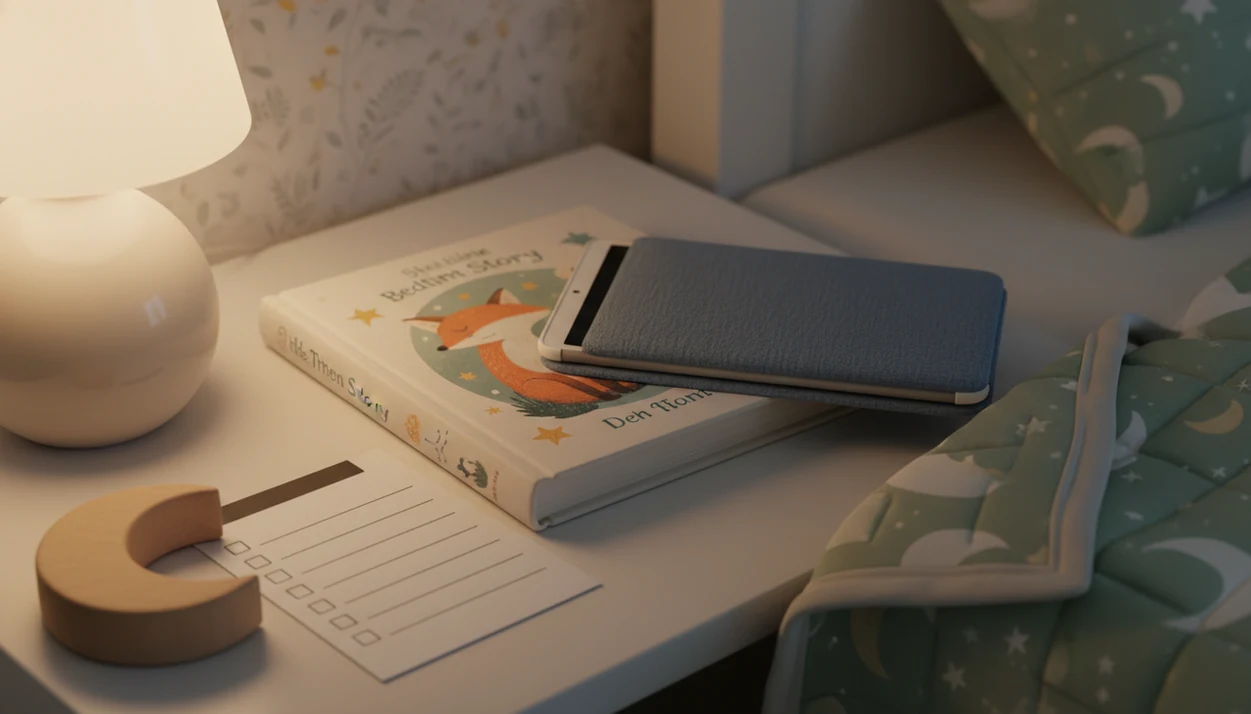
If you're asking "are AI bedtime stories safe for children," the safest answer is conditional: they can be reasonably safe when parents choose child-focused tools, preview the story first, and avoid open-ended child-to-AI chat. The safest setup is parent-controlled creation, age-appropriate themes, limited data collection, and no bedtime design that encourages endless engagement.
Definition: AI bedtime story safety means using artificial intelligence to create or narrate children’s sleep stories in a way that keeps parents in control of content, privacy, screen exposure, and emotional dependence.
TL;DR
- AI bedtime stories are safest when parents generate, review, and approve the story before a child hears it.
- The biggest risk is not AI storytelling itself, but open-ended chatbot interaction, weak filters, and unclear child data practices.
- AI stories should support bedtime routines, not replace shared reading, cuddling, or parent-child conversation.
AI Bedtime Story Safety at a Glance for Parents
AI bedtime stories are a spectrum of risk, not a yes-or-no safety category. The safest pattern is simple: the parent creates the story, the parent previews it, and the child hears only the approved version.
The riskiest pattern is different. A young child chats directly with an adult-oriented general AI chatbot at bedtime, asking follow-up questions without a parent seeing the answers. That setup can turn a quiet settling window into an unpredictable conversation.
Clinicians and child development groups typically recommend high-quality, age-appropriate media with adult involvement for young children. The American Academy of Pediatrics advises avoiding most digital media for children younger than 18 to 24 months, except video chatting, and emphasizes co-viewing and high-quality media for older children (https://www.healthychildren.org/English/family-life/Media/Pages/Where-We-Stand-TV-Viewing-Time.aspx).
Tools like Kids Bedtime TL fit the safer category when used as a bedtime-specific app for calm, parent-guided routines. Still, the parent remains the filter.
The hallway light matters.
How AI Bedtime Story Generators Work Behind the Scenes
AI bedtime story generators work by turning a parent’s prompt, age range, theme, character name, or mood into a predicted story sequence. The model uses language patterns to produce text, then the app may add narration, music, or a sleep-friendly format.
In plain terms, the prompt is the instruction and the model is the story builder. Safety enters through training data, content filters, app rules, moderation systems, and whether the child can chat freely. Filters reduce risk, but they cannot guarantee perfectly child-safe AI stories every time.
A finished story output is safer than an interactive AI companion because it can be reviewed before bedtime. An AI companion keeps responding, which creates more chances for odd advice, scary turns, or emotional dependence. Voice features add another layer. If a child’s voice is recorded, parents should ask where that recording goes and how long it stays.
How to use AI bedtime stories safely:
- Choose a child-focused tool with parent controls.
- Create the story before bedtime, not during a tired negotiation.
- Preview the full text or audio yourself.
- Play only the approved version to your child.
- Save calm favorites for nights when everyone is already stretched.
5 AI Bedtime Story Safety Facts for Parents
- Open-ended AI chatbots built for adults are higher risk for young children because they can produce unsafe, frightening, or age-inappropriate replies.
- Parent preview is safer than direct child generation because adults can remove fear-heavy plots, unsafe advice, or themes that do not fit the child’s age.
- Privacy policies matter because an AI bedtime story app may collect names, voices, prompts, favorites, behavior data, device identifiers, or listening history.
- Shared reading still matters. In the United States, 63.8% of children ages 3 to 5 are read to by a family member at least four days per week, according to NCES data (https://nces.ed.gov/).
- No AI system is completely safe, so supervision and limits remain necessary. A 2015 APA study of 6,150 children found higher language, literacy, and early reading scores among children regularly read to by caregivers (https://www.apa.org/pubs/journals/releases/dev-dev0000093.pdf).
For most families, parent-approved AI stories are safer than child-led AI chat because the adult can check tone, content, and privacy before the story reaches the pillow.
Tiny fingers clutching a blanket edge can make “Just one more story” feel hard to refuse.
Child-Safe AI Story App Checklist for Parents
App store availability or a kid-friendly label is not enough proof of safety. Parents should check how the app handles content, data, bedtime design, and child interaction before using it in a sleep routine.
| Safety criterion | Safer sign | Red flag |
|---|---|---|
| Parent preview | Full story can be reviewed first | Child generates stories alone |
| Child chat | No open-ended child-to-AI chat | Bot companionship at bedtime |
| Age controls | Toddler, preschool, or age-band settings | Same output for all ages |
| Privacy | Clear deletion and minimal data collection | Prompts or voices used for training |
| Sleep design | Short stories, gentle audio, no autoplay pressure | Streaks, endless scrolling, pushy notifications |
| Human support | Clear help and reporting path | No contact or safety process |
Avoid apps that pull bedtime toward more tapping. The phone set face-down on a dresser is often a good sign that the routine, not the screen, is leading.
A bedtime-specific category is useful here. Apps such as Kids Bedtime TL, Moshi, and Vooks are worth judging by bedtime controls, not just cute art or calm music. For toddler screen questions, the separate guide on should toddlers use screens before bed goes deeper.
Parent Approval Rules for an AI Bedtime Story App
Parent approval is the main safety layer for an AI bedtime story app. Toddlers and young children should experience the approved story, not negotiate with the AI while tired.
Use a parent-only creation flow. Make the story after pajamas and toothbrush, or earlier in the day if your evenings tend to hit the 7:15 p.m. scramble with one missing stuffed rabbit. Preview the whole text or audio before the child hears it.
Safe bedtime prompt ingredients
Use a clear age, calm tone, bedtime goal, and forbidden topics. For example: “Write a gentle 5-minute story for a 4-year-old about a sleepy fox getting ready for bed. No danger, punishment, monsters, separation, or scary ending.”
Story preview red flags
Reject stories with fear-heavy plots, shame, punishment, violence, unsafe advice, adult themes, intense separation, or endings that leave a child unsettled. If the story makes you want to explain too much at lights-out, choose another one.
Good kids bedtime stories, sleep meditation, lullabies, and nap routines for toddlers and young children deliver a predictable calm-down cue, not a promise to solve every sleep problem.
Privacy Risks in AI Bedtime Stories for Kids
What child data can AI bedtime story apps collect? Depending on the tool, they may collect names, ages, voices, prompts, favorite characters, listening patterns, device identifiers, and sleep routine data.
Personalization can be useful. A child may settle faster when the story includes a pet turtle or a familiar moon pillow. But personalization should not require excessive profiling, and parents should not enter full names, school names, home addresses, medical issues, family conflict, or private fears.
Look for clear deletion controls, minimal data collection, and plain language about whether prompts, voices, or listening history are stored or used for model training. If the privacy policy reads like a maze, pause.
This is not a rare family issue. In a nationally representative survey, 31% of parents of children under 12 reported that their child had engaged with voice-activated assistants such as Alexa or Siri (https://www.commonsensemedia.org/research/the-dawn-of-the-ai-era). The broader kids bedtime app privacy guide explains what to check before saving names, routines, or audio.
Common Myths About Child-Safe AI Stories
Myth 1: If an app is in the app store, it must be safe for kids. App review does not prove that every generated story, data flow, or chatbot response is appropriate for a tired preschooler.
Myth 2: AI bedtime stories are either completely safe or completely dangerous. Safety depends on design and supervision. Parent preview, no child chat, age controls, and calm bedtime limits all change the risk.
Myth 3: AI storytelling can replace parents at bedtime. It can help with ideas, variety, narration, or an offline routine, but it cannot read a child’s face or respond like a caregiver.
Myth 4: Kid-friendly labels remove the need for supervision. Labels are starting points, not guarantees.
Myth 5: Filters catch every violent, sexual, frightening, or unsafe output. Filters reduce risk, but generated content can still slip sideways.
The better question is not “Is AI safe?” It is “Who controls the story before my child hears it?”
Shared Reading and Parent Bonding AI Stories Should Not Replace
Can AI bedtime stories replace reading with a parent? No. AI can support ideas, variety, narration, and routine structure, but it should not replace live reading, cuddling, reassurance, or parent-child conversation.
Frequent shared reading is linked to stronger early literacy and language skills. A 2015 study of 6,150 children ages 3 to 5 found higher language, literacy, and early reading scores among children who were regularly read to compared with children who were rarely read to. That fits what many parents see at bedtime: dad repeating the sleepy refrain, a child correcting the animal voice, the same page requested again.
AI stories usually work best when they sit inside a predictable sequence, while parent reading fits the moments when a child needs connection, repair, or reassurance.
Kids Bedtime TL focuses on bedtime stories, sleep meditation, lullabies, and nap routines for toddlers and young children. Used carefully, that kind of tool can be a read-aloud option or audio support, not a replacement caregiver.
When to Seek Professional Help for Bedtime or Sleep Concerns
Seek professional help when bedtime struggles feel intense, persistent, medically unusual, or unsafe. AI stories can make a routine gentler, but they should not be used to treat a medical, emotional, or behavioral sleep disorder.
Call your pediatrician promptly if you notice breathing pauses, gasping, loud snoring with daytime exhaustion, repeated night pain, major anxiety, trauma-related nightmares, severe distress, or sleep loss that is affecting school, appetite, mood, safety, or family functioning. The same is true when a child seems terrified of sleep, has sudden changes after a stressful event, or needs a level of reassurance that no story or routine can reasonably provide.
Before you contact a clinician, make the pattern easier to see:
- Track bedtime, wake time, naps, night wakings, and how long settling takes.
- Note symptoms such as breathing changes, pain, panic, nightmares, or restless movement.
- Record recent changes, including illness, medication, travel, family stress, or screen use.
- Save what you have already tried, including stories, lights, timing, and comfort routines.
- Use the guide on when to call pediatrician for sleep as the next step.
Limitations
AI bedtime story safety is still an emerging topic, and parents should treat any single guide as practical context, not final proof.
- There is limited peer-reviewed research specifically on AI-generated bedtime stories and child safety.
- Much guidance is extrapolated from child media, shared reading, AI interaction, privacy, and developmental research.
- Safety filters and kid modes reduce risk, but they do not eliminate inappropriate outputs.
- Children may over-trust AI-like agents. An experimental robot conformity study found that young children could be influenced by a robot’s incorrect answers (https://www.science.org/doi/10.1126/scirobotics.aat7111).
- Privacy policies vary widely and may change over time after an app update.
- Parents may not always have time to preview every generated story, especially during travel or late-night wake-ups.
- Some children with anxiety, trauma histories, neurodevelopmental differences, or sleep disorders may need more tailored guidance.
- This advice is not a substitute for medical, psychological, or legal guidance.
If sleep concerns are persistent, intense, or linked with breathing, pain, trauma, or major distress, the guide on when to call pediatrician for sleep may help frame the next step.
FAQ
Are AI bedtime stories safe for my child?
AI bedtime stories can be reasonably safe when parents control creation, preview the full story, and use age-appropriate tools. They are not risk-free, especially if a child can chat directly with the AI.
Can toddlers use AI bedtime stories?
Toddlers should not directly interact with AI story tools. Parents should choose age-appropriate content, preview it first, and follow pediatric media guidance for young children.
Should children chat directly with AI at bedtime?
Open-ended child-to-AI chat at bedtime is higher risk than parent-approved story playback. A direct chat can produce unexpected content and may encourage emotional dependence.
Can AI bedtime stories accidentally become scary?
Yes, AI bedtime stories can become scary if prompts are vague or filters fail. Parents should preview every story before a child hears it.
Do AI story apps collect children’s data?
Some AI story apps may collect prompts, names, voices, usage patterns, or device data. Parents should read the privacy policy and look for deletion controls.
Are free AI bedtime story apps safe for kids?
Free AI bedtime story apps are not automatically safe or unsafe. Price does not prove safety, and some free tools may rely on data collection or weaker controls.
Can AI replace bedtime reading with a parent?
AI can supplement a bedtime routine, but it should not replace caregiver reading, bonding, reassurance, or conversation. Shared reading remains important for language and connection.
What features make an AI story app safer for kids?
Safer features include parent preview, age settings, limited data collection, strong filters, no child chat, and calm bedtime design. Kids Bedtime TL is one example to evaluate by those criteria.
Which AI bedtime story themes are safest for young children?
The safest themes are calm, familiar, low-conflict stories with gentle endings. Avoid intense fear, danger, shame, punishment, separation, or adult themes.