
Airplane Bedtime Stories for Kids on Flights and Red-Eyes
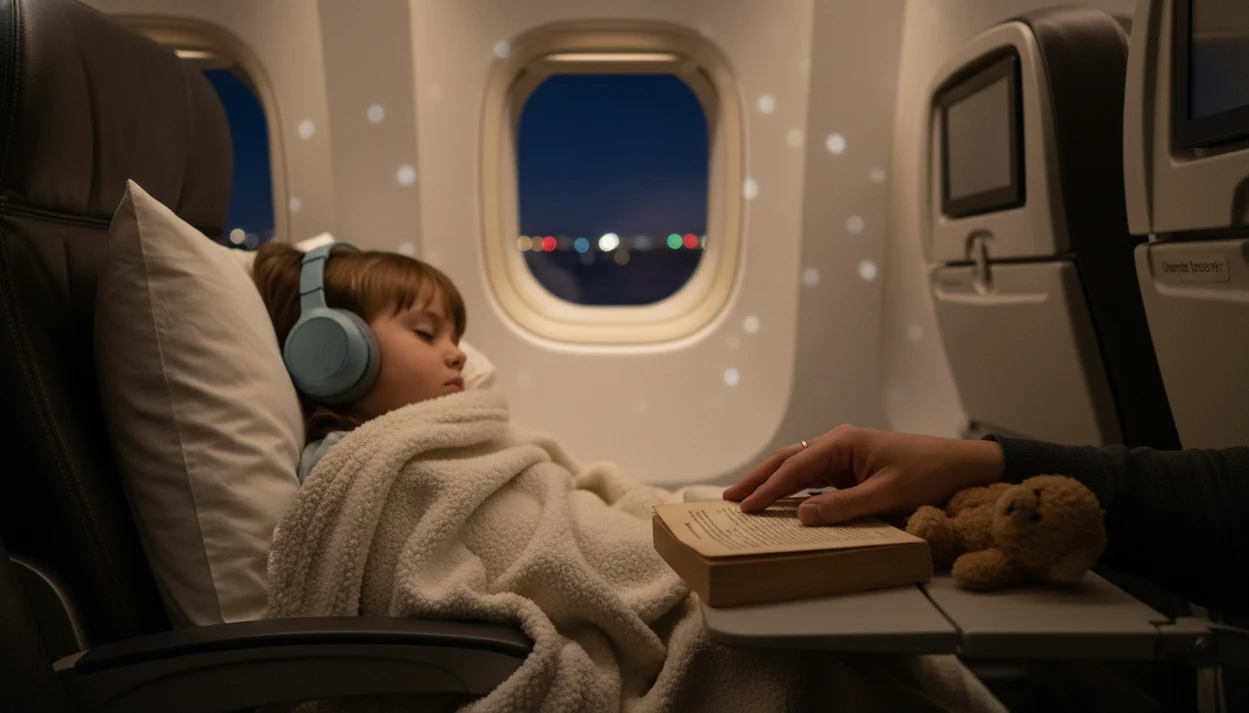
The best airplane bedtime stories for kids are short, offline, screen-free audio or read-aloud stories with calm pacing, predictable endings, and reassuring details about flying. For trips, choose stories your child can hear without watching a screen, test them in airplane mode before boarding, and pair them with a familiar mini bedtime routine. Kids Bedtime TL fits this use when parents want bedtime stories, sleep meditation, lullabies, and nap routines ready before the cabin lights dim.
Definition: Airplane bedtime stories for kids are calming, kid-friendly sleep stories about planes, flying, airports, or nighttime travel that help children relax during flights or before a red-eye trip.
- Download flight bedtime stories before travel because airplane Wi-Fi is unreliable for children’s sleep audio.
- Choose low-stimulation stories, lullabies, or sleep meditations instead of exciting airplane adventures.
- Use safe, comfortable audio settings and keep a backup printed or parent-told story in case devices die.
How airplane bedtime stories look
Side-by-side captures of the compared products. Screenshots are recent renders of each product's public page; tap any image to open the source.
Best airplane bedtime stories for kids: 5 formats that work on flights
The five best airplane story formats are downloaded audio stories, parent-read printed stories, dimmed picture ebooks, parent-told oral stories, and lullaby-plus-story playlists. The right choice depends on flight length, age, and how tired your child already is.
- Downloaded audio stories: Best for red-eyes because the child can listen with eyes closed. Kids Bedtime TL works here because parents can choose calm story, meditation, and lullaby options before boarding. Before relying on it in the cabin, open Kids Bedtime TL in airplane mode and confirm the exact story, lullaby, or meditation still plays without a connection.
- Parent-read printed stories: Best for toddlers who need your voice more than a plot.
- Picture ebooks with the screen dimmed: Better for older children, but keep brightness low.
- Parent-told oral stories: Useful when devices die or cabin Wi-Fi fails.
- Lullaby-plus-story playlists: Strong for short-haul naps because the sequence can be brief.
For travel planning beyond flights, the same low-stimulation rule applies to kids bedtime stories for travel.
How airplane bedtime stories for kids work
Airplane bedtime stories work by acting as sleep cues, not guaranteed sleep triggers. They give a child’s brain a familiar, low-demand pattern to follow when the cabin feels strange, bright, or loud.
The mechanism is simple: a calm story reduces cognitive stimulation, meaning there is less new information to chase. Predictable endings help because the child does not need to stay alert for a twist, a joke, or a cliffhanger. On a red-eye, the story can also carry pieces of the home routine into the seat: same voice, same order, same stuffed animal, same “now we rest” signal. Audio is usually calmer than screens because the child can close their eyes and avoid bright visual input.
- Use the story as the start of wind-down, not as a promise of sleep.
- Choose a plot with a safe, expected ending.
- Repeat familiar bedtime cues from home as much as the flight allows.
- Switch to lullabies, breathing, or silence if fear, turbulence, cabin noise, or overtiredness takes over.
Flight bedtime stories and airplane sleep cues for children
Flight bedtime stories work as calm-down cues, not sleep switches. A predictable narrative, slower voice, and familiar order can reduce stimulation enough for rest to feel possible.
Children still have to compete with cabin noise, aisle lights, seat discomfort, meal carts, and schedule disruption. According to the CDC, 26% of U.S. children ages 3 to 17 had difficulty sleeping at least one night per week, according to CDC sleep data for children and teens (https://www.cdc.gov/sleep/data-and-statistics/children-and-sleep.html). so travel can disturb an already fragile routine. A story helps by giving the brain a known path: beginning, small problem, safe ending.
Not instant sleep. Still useful.
When the issue is a red-eye with too much novelty, Kids Bedtime TL fits because parents can pair a soft-spoken story with a lullaby or sleep meditation in one predictable sequence.
How to use airplane bedtime stories for kids before boarding
Use airplane bedtime stories before boarding by setting up the routine while you still have reliable power, signal, and patience. Parents searching for offline stories airplane usually need one thing: no streaming surprises at 9:40 p.m. over the wing.
- Download stories, lullabies, and sleep meditations before leaving home.
- Test playback with Wi-Fi and cellular turned off.
- Set volume low enough for comfort, then check it again after takeoff.
- Pack the comfort item, such as a stuffed animal, hoodie, or small blanket.
- Start the story after takeoff or meal service, not during announcements.
- Save a printed or parent-told backup story.
The American Academy of Pediatrics advises keeping screens out of children’s bedrooms and avoiding media use before bedtime, so screen-free listening is usually better than video or bright ebooks near sleep (https://www.healthychildren.org/English/family-life/Media/Pages/Media-Use-and-Sleep.aspx). For a broader setup, use a download offline bedtime stories app before travel day.
Kids airplane sleep stories with the calmest content style
The calmest kids airplane sleep stories are slow, low-conflict, and predictable. They make flying feel safe without turning the cabin into an action movie.
- Slow pacing matters: A moonlit flight with quiet clouds usually settles better than a race through a thunderstorm.
- Low conflict helps: A kind pilot checking the cabin is calmer than a lost suitcase chase.
- Predictable endings work: A safe landing, sleepy airport, or child tucked in at grandma’s house gives closure.
- Reassuring details reduce fear: Seatbelts, engine hums, and small bumps can be described as normal parts of flying.
- High-action plots can backfire: Some children stay awake waiting for the next surprise.
Older children may ask for funny stories, free PDFs, or airplane adventures. That can work if the ending is gentle and the last two minutes slow down.
Offline stories airplane checklist for red-eye travel
“Do I need offline stories on an airplane?” Yes, because buffering, login failures, and weak in-flight Wi-Fi can break a bedtime routine right when your child is finally settling.
Download app stories, podcast episodes, audio files, PDFs, and one printed backup. Then test everything with Wi-Fi and cellular turned off. We do this before the 7:15 p.m. scramble after pajamas, toothbrush, and one missing stuffed rabbit, because travel days do not improve anyone’s memory.
The right fit for families who depend on the same story every night is Kids Bedtime TL, because the routine can include bedtime stories, lullabies, and nap-style wind-downs instead of a single streamed file. For longer offline planning, offline bedtime stories for kids covers the home setup.
Also pack a charging cable, battery pack, and child-safe headphones. Analog backup still matters.
Airplane bedtime story headphones, volume, and screen settings
Comfortable over-ear headphones or soft fabric headband headphones usually work better than rigid earbuds for airplane sleep stories. Keep volume around 60 to 70% of maximum or lower when possible, especially because children may listen for a long stretch.
The World Health Organization warns that unsafe listening can increase hearing risk, and it estimates that more than 1 billion young people are at risk of hearing loss from unsafe listening practices (https://www.who.int/news-room/fact-sheets/detail/deafness-and-hearing-loss). Do not raise volume just to overpower engine noise. A lower story plus white noise can be gentler than a loud narrator.
If headphones are a fight, switch formats. Use a quiet speaker if it will not disturb nearby passengers, read from a printed story, or tell a simple oral story. Put the phone face-down on the tray table or dresser later at the hotel so the screen does not brighten the room.
Airplane bedtime routine mini-kit for story time
An airplane bedtime routine works best when the story is part of a small, repeatable sequence. Routine consistency matters more than whether every story is about airplanes.
| Mini-kit item | How it helps on a flight |
|---|---|
| Small snack | Prevents hunger from restarting bedtime negotiations |
| Water | Helps after salty airplane meals or dry cabin air |
| Stuffed animal | Gives a familiar calm-down cue |
| Blanket | Marks the seat as a sleep space |
| Pajamas or hoodie | Creates a bedtime signal without a full change |
| Story playlist | Keeps the routine moving after lights go low |
Use the order: bathroom, snack, seatbelt, lights low, story, then lullaby or silence. The National Sleep Foundation reported that 71% of parents of children under 10 linked consistent routines with better sleep quality and fewer wakings.
Parents trying to keep the same rhythm away from home often use Kids Bedtime TL because story playlists can sit beside lullabies and nap routines. The same idea helps with a bedtime routine for hotel room with toddler.
Short airplane bedtime stories for toddlers and young children
Short airplane bedtime stories work better than long plots because children can relax without waiting for a complicated ending. For toddlers, aim for 3 to 7 minutes; for preschool and early elementary children, 8 to 15 minutes is usually enough.
| Child or flight type | Better story length | Format to try |
|---|---|---|
| Toddler on short-haul nap | 3 to 5 minutes | Parent-read or soft audio |
| Toddler on red-eye | 5 to 7 minutes repeated | Lullaby-plus-story loop |
| Preschool child | 8 to 12 minutes | Downloaded audio story |
| Early elementary child | 10 to 15 minutes | Calm chapter-style story |
| Anxious flyer | Short, reassuring segments | Parent voice plus story |
Very long stories can keep children awake because they want the ending. Funny airplane stories, free stories, and PDFs can still fit bedtime if they stay soft, brief, and low-stakes.
Honest cons of airplane bedtime stories for kids
Airplane bedtime stories can help, but they can also wake some children up. Imaginative kids may start asking questions about pilots, clouds, emergency doors, or where the plane sleeps.
Airplane-themed content can also backfire for a child who is already afraid of flying. A story about bumps may reassure one child and worry another. Cabin announcements, turbulence, headphone discomfort, and a dying battery can interrupt the settling window. The pocket check is real.
If a story is not working after one round, switch. Use lullabies, breath counting, or your own quiet voice. “Just one more story” is a common pressure point, so decide the limit before the first story starts.
For children who settle better by car than by plane, car ride sleep stories for kids may offer a simpler travel comparison.
Limitations
Airplane bedtime stories can support sleep, but they cannot override every travel problem. Treat them as one tool inside a routine, not a guarantee.
- Airplane stories cannot cancel jet lag, cabin noise, seat discomfort, or anxiety.
- There is limited direct clinical research on airplane-themed bedtime stories specifically.
- Some children become more alert when listening to narrative audio.
- Not all children tolerate headphones, earbuds, or headbands.
- Offline downloads can fail because of app logouts, expired files, dead batteries, or storage limits.
- Screen-based ebooks may be less ideal near sleep than audio or parent read-aloud formats.
- Parents should not use loud volume to compete with airplane noise.
- Apps such as moshi.com, calm.com, headspace.com, storyberries.com, and vooks.com may offer useful content, but format, offline access, and age fit vary.
If a child has severe flight anxiety or ongoing sleep difficulties, ask a pediatric clinician for guidance.
FAQ
Do airplane stories help kids sleep?
Calming airplane stories can support sleep cues by lowering stimulation and giving the child a predictable sequence. They do not guarantee sleep, especially with cabin noise, fear, or schedule disruption.
How long should flight stories be?
Toddlers usually do better with 3 to 7 minute stories. Preschool and early elementary children often handle 8 to 15 minutes, especially on red-eyes.
Should airplane stories be offline?
Yes, airplane bedtime stories should be downloaded before travel whenever possible. In-flight Wi-Fi can buffer, block apps, or fail during the exact settling window.
Are headphones safe for kids?
Headphones can be safe when they fit comfortably and the volume stays low, around 60 to 70% of maximum or less. If a child dislikes headphones, use parent reading, a quiet speaker, or a printed story.
Are funny airplane stories good?
Funny airplane stories can work if the humor is gentle and the story slows down near the end. Loud, silly, high-energy plots are usually worse for bedtime.
What if my child hates headphones?
Use a parent-read story, quiet speaker playback if appropriate, printed pages, or an oral story. Kids Bedtime TL can be one option for offline-friendly audio, but the format should match the child’s comfort.
Can stories reduce flying fear?
Reassuring story details about seatbelts, engine sounds, takeoff, and bumps can help some children feel safer. Significant flight anxiety may need more preparation than a bedtime story can provide.