
Bedtime Routine For 3 Year Old Children Who Stall
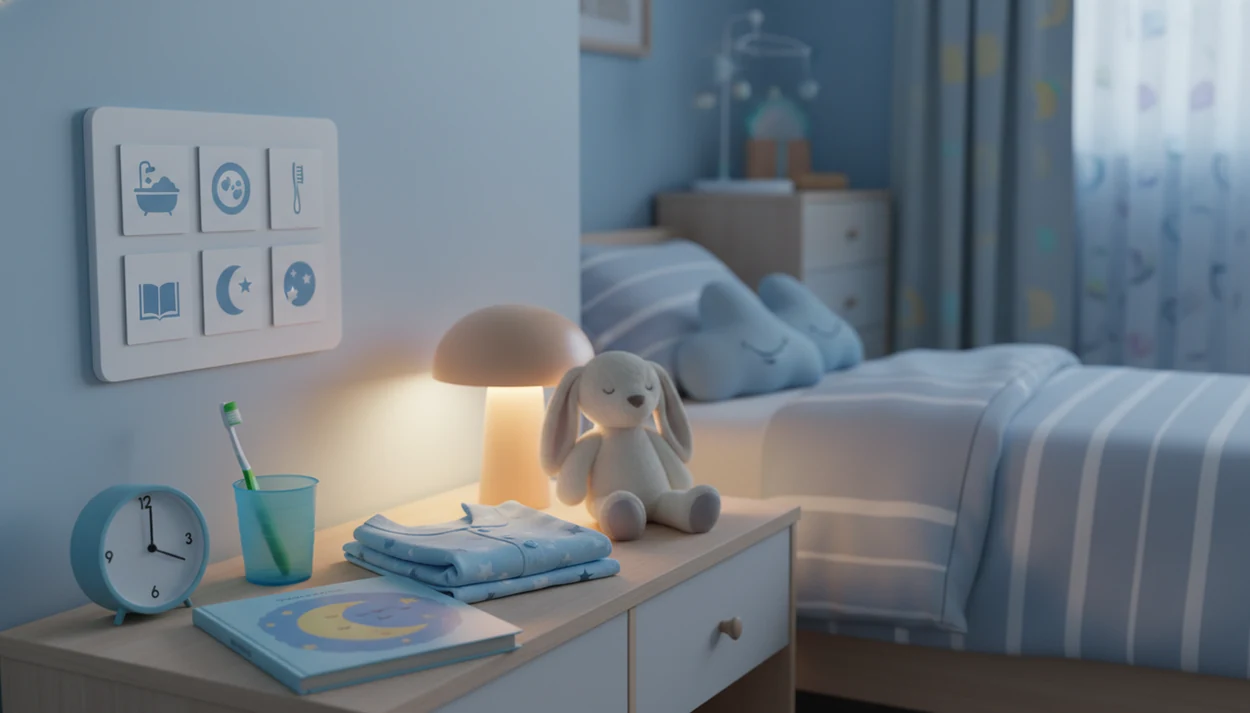
A bedtime routine for 3 year old children works best when it is short, visual, screen-free, and repeated in the same order every night. Use a 20- to 30-minute sequence: bathroom, pajamas, teeth, one calm story or lullaby, one final goodnight, then lights out.
Definition: A 3 year old bedtime routine is a predictable sequence of calming bedtime steps that tells a preschooler sleep is next and limits opportunities to stall.
- Most 3-year-olds need 10 to 13 hours of total sleep in 24 hours, according to the American Academy of Sleep Medicine consensus recommendation for ages 3 to 5 (https://jcsm.aasm.org/doi/10.5664/jcsm.5866), so bedtime should protect that sleep window.
- Keep the routine boring, repeatable, and screen-free: bathroom, pajamas, teeth, story, goodnight, lights out.
- Toddler stalling bedtime usually improves when parents set the limit before the request: one drink, one story, one final hug.
At-a-glance 3-year-old bedtime routine chart
A useful 3-year-old bedtime routine is short enough to repeat on tired nights and clear enough for a preschooler to picture. The order matters more than the exact activities, because the sequence becomes the calm-down cue.
| Step | Parent phrase | Time estimate |
|---|---|---|
| Bathroom | “Try now, then bathroom is done.” | 2 minutes |
| Pajamas | “Pajamas on, then teeth.” | 3 minutes |
| Teeth brushing | “Open wide, then story.” | 3 minutes |
| One short story | “One story, then our song.” | 5 to 8 minutes |
| Lullaby or sleep meditation | “Quiet bodies now.” | 3 to 5 minutes |
| Final goodnight | “I love you. I’ll see you in the morning.” | 1 minute |
| Lights out | “Lights out. Sleep time.” | Immediate |
A visual chart helps many 3-year-olds follow the sequence without repeated negotiation. At 7:15 p.m., when pajamas, toothbrush, and one missing stuffed rabbit all collide, the chart gives everyone something neutral to point toward.
How a preschool bedtime routine works at age 3
A preschool bedtime routine works by turning sleep into a predictable behavioral loop: same cue, same order, same ending, less negotiation. Three-year-olds still struggle with time, delayed consequences, and “five more minutes,” so visible steps are easier than verbal promises.
The mechanism is simple. A cue starts the loop, the routine repeats in the same order, and the final phrase closes the loop. Calm stories, lullabies, and sleep meditation work best as low-stimulation settling tools, not as entertainment that invites jokes, questions, and plot debates.
Quiet beats loud.
According to the American Academy of Sleep Medicine consensus recommendation, children ages 3 to 5 generally need 10 to 13 hours of sleep in 24 hours (https://jcsm.aasm.org/doi/10.5664/jcsm.5866). For many families, a predictable preschool bedtime routine protects that sleep window better than a nightly discussion.
Before starting a bedtime routine for 3-year-old children
Before starting, set the sleep window and prepare the room so the routine does not begin already behind. Clinicians typically recommend consistent bedtime cues, enough total sleep opportunity, and a calm pre-bed environment for young children.
- Sleep total: Choose a bedtime that allows 10 to 13 hours of total sleep in 24 hours, including naps.
- Clock time: Many families land around 7:00 to 8:30 p.m., depending on wake time, nap length, and daycare schedules.
- Screens: Avoid screens for 1 hour before bed when possible, even if the child looks quiet.
- Supplies: Put pajamas, toothbrush, water, and the story choice ready before the child is overtired.
- Room setup: Keep light low, noise steady, and toys limited to one comfort object.
The hallway light left cracked open while a parent starts the same story again is normal. The goal is not drama-free bedtime. It is fewer moving parts.
How to use a bedtime routine for 3-year-old stalling
Use the routine as a script, not a debate. For a 3-year-old who stalls, the bedtime sequence should answer predictable requests before they become negotiations.
- Set the bedtime window from wake time, nap length, and the child’s last-hour mood.
- Show the visual chart before the routine starts, not after the first refusal.
- Run the same sequence every night: bathroom, pajamas, teeth, story, lullaby, goodnight.
- Offer one controlled choice, such as blue pajamas or green pajamas.
- End with the same goodnight phrase so the routine has a clear finish.
- Reset calmly after stalling: “The chart is done. It is sleep time.”
For a 3-year-old, a controlled choice is often easier than an open question because it keeps the parent in charge of the boundary. The full toddler bedtime routine checklist can help if you want the same steps printed or saved.
Step 1: Set the 3-year-old bedtime window
“What bedtime should my 3-year-old have?” There is no universal clock time; the right bedtime depends on wake time, nap length, and how your child behaves in the last hour before bed.
Watch the pattern for several nights. If your child gets wild energy, cries over small things, makes repeated demands, or seems to catch a second wind, bedtime may be too late. Move lights-out earlier by 10 to 15 minutes for several nights, then reassess.
The parent phrase can stay plain: “Your body is tired, so we are starting early tonight.” No lecture needed. For many families, a bedtime routine timeline is useful because it works backward from the morning wake-up instead of copying someone else’s bedtime.
The most common medically supported way to protect a preschooler’s sleep window is a consistent bedtime paired with enough total sleep opportunity.
Step 2: Build a short preschool bedtime routine sequence
Build the sequence so each step leads to the next without a new decision. If supper is already done, the routine can often start about 20 minutes before bedtime; when supper is included, the whole evening flow may take 30 to 45 minutes.
- Tidy one toy, not the whole room.
- Use the bathroom once.
- Put on pajamas.
- Brush teeth.
- Read one short, calm story.
- Play a lullaby or brief sleep meditation, then turn lights out.
Stories should be gentle and predictable, not interactive or silly. A dad repeating the sleepy refrain can be soothing; a dinosaur voice contest usually is not. Good kids bedtime stories, sleep meditation, lullabies, and nap routines for toddlers and young children deliver predictable calm-down cues, not a guaranteed sleep result.
For preschoolers, a short routine is often easier than a long routine because fewer steps create fewer chances to renegotiate.
That advice is supported by clinical sleep research: a randomized study of nightly bedtime routines in young children found improvements in sleep onset, night wakings, and caregiver mood after two weeks (https://pubmed.ncbi.nlm.nih.gov/19403557/).
Step 3: Stop toddler stalling bedtime requests
Toddler stalling bedtime requests usually need short scripts and a one-time pass, not longer explanations. Repeated “just one more” responses often train more negotiation, even when they feel kind in the moment.
Water, bathroom, and extra hug scripts
- Water: “You had your drink; now it is sleep time.”
- Bathroom: “You tried. Bathroom is done until morning unless it is urgent.”
- Extra hug: “One more hug, then I am leaving.”
- Different pajamas: “These are tonight’s pajamas.”
- Parent staying longer: “I will check on you after I put the cup away.”
A one-time pass works well for predictable needs. Give one drink, one bathroom try, or one extra hug before lights out, then close the loop.
One more story boundary
“Just one more story” is a common bedtime pressure point. Answer before the request: “We are reading one story tonight. Tomorrow you can choose again.”
The pause button tapped during a yawn can be a good ending. Stop while the room is still calm.
Common myths about a bedtime routine for 3-year-old children
Several common bedtime beliefs make the routine longer than it needs to be. Replace them with boundaries that are kind, boring, and repeatable.
- Myth: A longer routine works better. Better belief: a short routine is easier to repeat when everyone is tired.
- Myth: One more story prevents a meltdown. Better belief: a clear limit may cause protest at first, but it reduces nightly bargaining.
- Myth: Stalling always means defiance. Better belief: stalling can come from overtiredness, separation worry, hunger, or too much stimulation.
- Myth: Screens are fine if the child looks calm. Better belief: quiet screen-watching can still make settling harder for many children.
- Myth: A reward chart fixes bedtime. Better belief: charts help most when the adult limit stays consistent.
If you want more source-based context, bedtime routine benefits explains why predictability matters over time.
How to check whether the 3-year-old bedtime routine is working
A bedtime routine is working when bedtime battles get shorter and settling becomes more predictable, not when a child falls asleep instantly. Track bedtime start, lights-out time, number of stall requests, and morning mood for 7 nights.
Change only one variable at a time. Move bedtime earlier, shorten the story, or remove screens, but do not change everything on the same night. Otherwise, you will not know what helped. The pocket check is real: pacifier, water, stuffed animal, charger, then door.
Tools like Kids Bedtime TL can support the content part of the routine with calm stories, sleep meditation, lullabies, and nap routines. Keep the phone face-down on a dresser so the screen does not brighten the room, and treat the audio as one step, not an open-ended menu.
Progress usually looks like fewer negotiations before it looks like faster sleep.
Limitations
A bedtime routine helps many 3-year-olds, but it is not enough for every sleep problem. Use it as a practical structure, not as a test of good parenting.
This guide is educational and is not a diagnosis or treatment plan. If sleep problems are severe, sudden, or paired with breathing symptoms, pain, or major anxiety, use the routine as background information and ask a pediatric clinician.
- A routine will not fully fix chronic overtiredness, inconsistent naps, or an irregular schedule.
- No single routine works for every temperament, sibling setup, daycare nap pattern, or family work schedule.
- Reward charts rarely solve bedtime battles without consistent limits from the adult.
- A routine that is too long, exciting, or flexible can create more stalling.
- Frequent night waking, snoring, breathing pauses, pain, or major anxiety may need pediatric evaluation.
- Travel, illness, daycare nap changes, and new siblings can temporarily disrupt progress.
- Some children need extra support for separation anxiety, sensory needs, or medical issues.
If the routine worked for two weeks and then fell apart after a rental house hallway night-light, reset gently. Familiar steps still count away from home.
FAQ
What bedtime should a 3-year-old have?
Most 3-year-olds do well with a bedtime that allows 10 to 13 hours of total sleep in 24 hours. Use wake time, nap timing, and evening mood to choose the exact clock time.
How long should bedtime take for a 3-year-old?
A bedtime routine for a 3-year-old usually works best at about 20 to 30 minutes if supper is already done. If it regularly stretches past 45 minutes, it may be giving too many chances to stall.
Should a 3-year-old still nap before bedtime?
Many 3-year-olds still nap, but nap length and timing affect bedtime. A late or long nap may push bedtime later, while no nap may require an earlier bedtime.
How many bedtime stories should a 3-year-old get?
One short bedtime story is usually enough for a 3-year-old. Extra stories can become a stalling pattern if the limit changes after protest.
Why does my 3-year-old stall at bedtime?
A 3-year-old may stall because of overtiredness, separation worries, inconsistent limits, hunger, or a routine that is too stimulating. Stalling is common and does not always mean defiance.
Are screens bad before bedtime for 3-year-olds?
Screens are usually best avoided in the hour before bed for 3-year-olds. Even calm-looking screen time can delay settling for some children.
Should I use a visual bedtime chart for my 3-year-old?
A visual bedtime chart can help a 3-year-old follow the routine because pictures are easier to understand than repeated verbal reminders. It works best when the same steps happen in the same order.
When should I call a pediatrician about my 3-year-old’s sleep?
Call a pediatrician if your child has loud snoring, breathing pauses, pain, severe anxiety, frequent night waking, or persistent sleep disruption. A routine should not replace medical evaluation when red flags are present.